
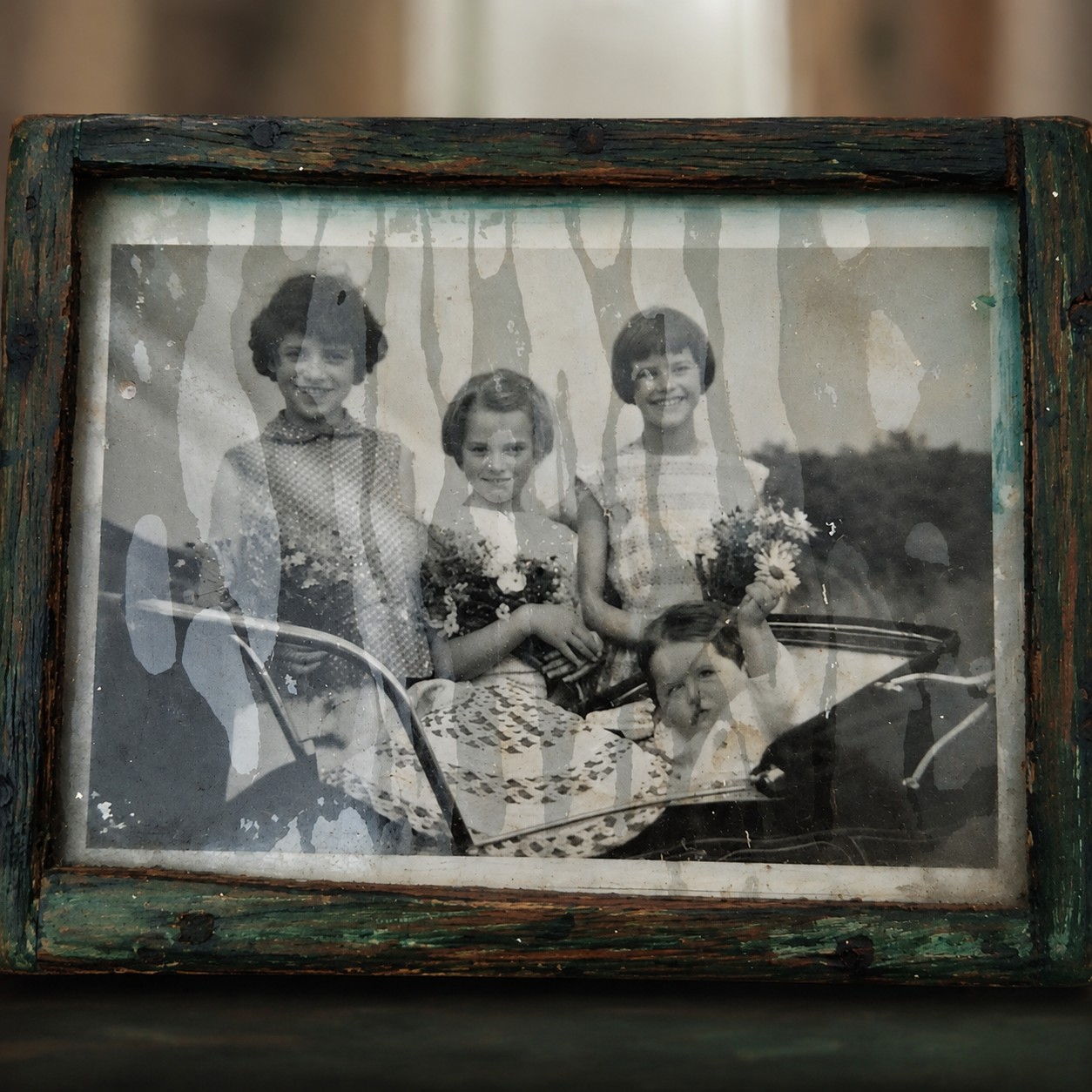
There is something magical about old photographs.
Not because they’re perfect—they rarely are.
They’re faded, creased, tucked into biscuit tins, old albums, or sitting quietly in frames on mantelpieces. Some have names written on the back. Others have none at all.
Yet every one of them holds a story.
We tend to look at the faces first.
Who they were.
How young they looked.
What they were wearing.
But photographs only capture a fraction of a second.
They never tell us what happened before the shutter clicked, or what happened after.
They can’t tell us who was making everyone laugh.
Who had argued on the way there.
Who couldn’t wait to get home for their tea.
Or who would be gone far too soon.
The older I get, the more I realise photographs aren’t just pictures.
They’re time capsules.

My Neighbour Christine, aged 8, with her sisters outside the Rising Sun Pit, a working coal mine, in Whitley Bay, North East England in 1958. Christine is 76 now.
They hold memories of a time that is slowly fading from our collective memory, and of a generation whose way of life was so different from today.
There were no mobile phones.
No internet.
No social media.
If you wanted to know how someone was, you knocked on their door.
Communities weren’t perfect, but they were connected.
Neighbours looked out for one another.
Children filled the streets until teatime.
The kitchen wasn’t just a room.
It was the heart of the home.
There was always a kettle on.
Women gathered around kitchen tables, sharing stories, passing on family news, laughing through hard times, and somehow holding family life together.
Most of the time, we had very little.
But somehow, it felt like enough.
I don’t see much of that today.
The pace of life has changed.
Technology has brought us many wonderful things, but somewhere along the way we’ve lost some of those everyday connections that once held communities together.
Many of the memories that inspired Poetry in a Northern Kitchen began with photographs just like these.
A familiar smile.
A favourite dress.
A child holding someone’s hand.
One faded image can unlock an entire afternoon from fifty or sixty years ago.
Suddenly you’re not just looking at a photograph anymore.
You’re hearing the laughter.
Smelling Sunday dinner.
Listening to the kettle whistle.
Standing once again in a warm Northern kitchen where everyone somehow found room around the table, no matter how small the house.
That’s what this collection means to me.
It’s about preserving the stories that photographs alone can never tell.
Because one day, we’ll all become someone’s old photograph.
And I hope the stories we leave behind are remembered just as warmly as our faces.
Thank you for reading
Your DislexicPoet 🖤
Leave a Reply