
People often imagine writers in quiet cafés, expensive offices, perfectly lit desks with leather journals and fancy coffee beside them.
But most of my poetry is not written like that.
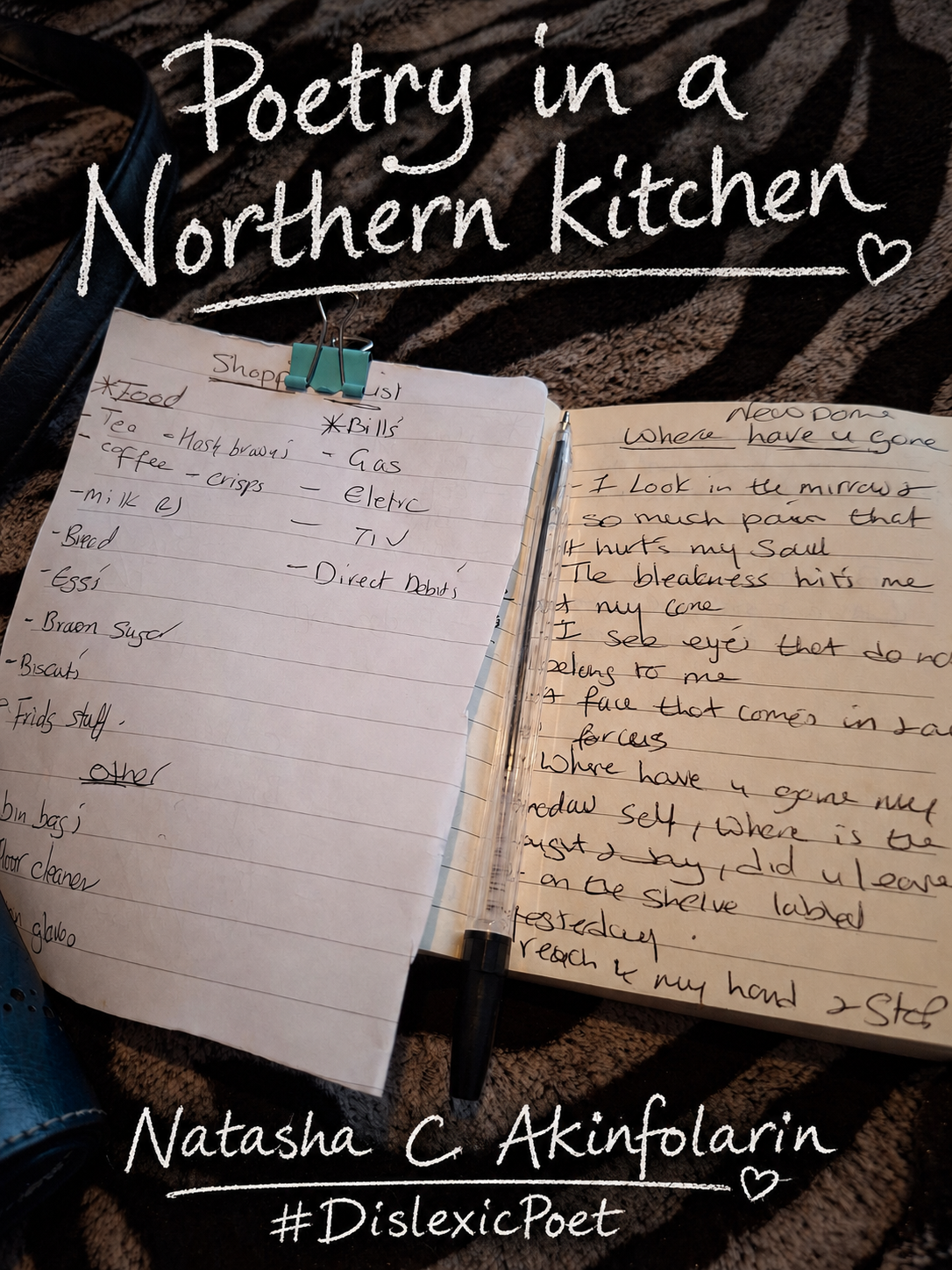
It is written between shopping lists, bills, direct debits, cold cups of tea, and the exhaustion of everyday life.
It is written in ordinary spaces.
A Northern kitchen.
A blanket over my knees.
A notebook balanced beside me.
The sound of life still happening around me.
Sometimes there are poems beside reminders to buy milk.
Sometimes there are spoken-word drafts beside gas bills.
Sometimes there are thoughts about survival written beside “fridge stuff.”
And honestly, I think there is something beautiful about that.
Because this is what creativity looks like for a lot of working-class people.
We do not always have the luxury of perfect writing spaces.
We create in-between things.
In-between shifts.
In-between stress.
In-between survival.
The poetry still gets written anyway.
In my life, my poetry happens in-between catching the bus and ringing the bell for my stop, and shopping trolleys being pushed around the supermarket.
That is where most of my poetry comes from — deep within human experience. Rugged like a rough diamond, but shining all the same.
That’s real life to me.
That is where most of the ideas for my poetry pieces come from.
I think social media sometimes forgets that art does not have to look polished to be meaningful.
Not every poet writes from a minimalist studio apartment with aesthetic lighting and expensive notebooks. (There’s nothing wrong with that but it’s just not me)
Some of us write from cluttered kitchens.
From small homes.
From tired bodies and overworked minds.
From real life.
And maybe that is why raw writing connects so deeply with people.
Because they can feel the truth inside it.
The shopping list beside the poem is not ruining the art.
It is part of the art.
It tells the story of the person writing it.
A person trying to survive, create, think, feel, heal, remember, and still hold everyday life together all at once.
That feels far more honest to me than pretending creativity exists separate from ordinary life.
This is poetry in a Northern kitchen.
And maybe that is exactly where some of the best poetry belongs.
Thank you for reading
Your DislexicPoet 🖤